
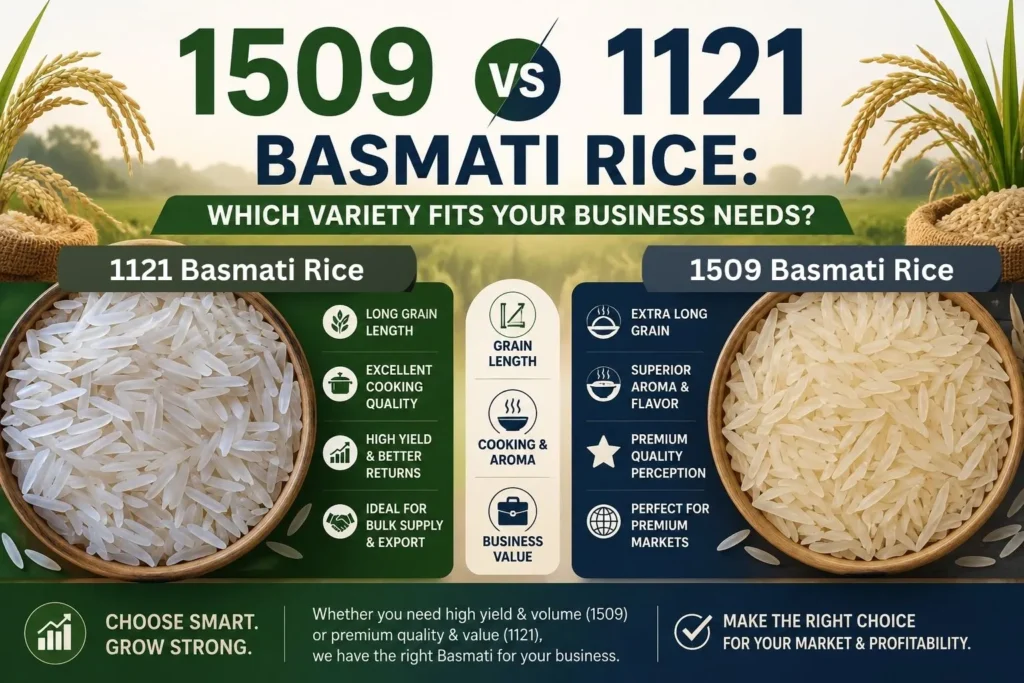
Deciding between 1509 and 1121 Basmati Rice may affect the pricing of your product, as well as your customer satisfaction and positioning as a business. Though both these types of rice are popular within domestic and foreign markets, these two are not meant for exactly the same consumer needs.
If you are an importer/exporter, retailer, food brand or part of the hospitality sector, having knowledge of the practical differences of the two types of rice with respect to Shree Krishna Exports (Tasty Grain) may be helpful in making a better purchasing decision. Here is a quick comparison between the two:
1509 Basmati Rice: A Smart Choice for Value and Versatility
1509 Basmati Rice is very popular because of its early-maturing Basmati rice and its commercial qualities. In the business world, one of its greatest benefits is the equilibrium it brings between its quality and its prices. It caters to those who wish to offer their clients basmati quality without necessarily going to the top premium price range.
1509 Rice would suit you if you:
- Competitive pricing for your target market
- A versatile option for wholesale and retail supply
- Different processing options based on buyer requirements
It is particularly suitable for businesses targeting price-sensitive markets while still maintaining a strong Basmati product offering.
1121 Basmati Rice: Built for Premium Market Appeal:
1121 Basmati rice is renowned for its excellent elongation quality after cooking, which gives it an attractive appearance on the plate.
Such a type of rice is normally favoured by people where looks are equally important as taste and aroma. The best quality retailers, exporters, hotels, restaurants, and caterers prefer to use such kinds of rice varieties.
1121 Basmati Rice is ideal when your customers expect:
- Excellent elongation after cooking
- Premium product presentation
- Quality suitable for premium retail and foodservice markets
If your business strategy focuses on premium customers and higher-value product positioning, 1121 can be the stronger option.
1509 vs 1121 Basmati Rice: A Quick Comparison
Features | 1509 Basmati Rice | 1121 Basmati Rice |
Grain type | Long & slender | Extra-long & slender |
Cooking performance | Good elongation | Exceptional elongation |
Market position | Value to mid-premium | Premium |
Pricing approach | More competitive | Higher value positioning |
Best for | Wholesale, retail & regular consumption | Export, premium retail, hotels & restaurants |
Main advantage | Quality with commercial value | Exceptional grain length & presentation |
Which One Should Your Business Choose?
The simplest way to decide is to look at who you are selling to.
If you are concerned about providing a quality Basmati Rice that will have a commercial edge for your customers, then go for 1509 Rice. This variety may be suitable for wholesalers, distributors, retailers, and even businesses having a market where prices hold an important factor.
When you want to reach out to consumers who require high-quality looking grain with good elongation, choose 1121 Rice.
In many cases, businesses can also benefit from offering both varieties. This allows them to serve different customer segments instead of limiting their portfolio to a single price range.
Find the Right Basmati Rice for Your Market with Tasty Grain
At Shree Krishna Export (Tasty Grain), enterprises have the freedom to select the appropriate type of Basmati rice according to the needs of their target market. You may decide whether you need 1509 Rice or 1121 Rice depending on your market and strategy for your business.
Understand your market and select the best Basmati variety for sustainable business development.
Frequently Asked Questions
1509 Basmati Rice is a commercially competitive Basmati variety suitable for value-focused markets, while 1121 Basmati Rice is a premium variety known for its extra-long, slender grains and excellent elongation after cooking.
1509 Basmati Rice can be a suitable choice for wholesale businesses that prioritize competitive pricing and commercial value. 1121 Basmati Rice is better suited to wholesalers serving premium customers who value longer grains and attractive presentation.
1121 Basmati Rice is generally better suited to premium markets because of its extra-long grain appearance and excellent elongation after cooking. It is commonly suitable for premium retail, hotels, restaurants, catering, and foodservice applications.
Businesses should choose based on their target market, customer preferences, pricing strategy, and product positioning. 1509 Basmati Rice is suitable when competitive pricing is important, while 1121 Basmati Rice is suitable when premium grain appearance and presentation are priorities.
Yes. Businesses can offer both 1509 Basmati Rice and 1121 Basmati Rice to serve different customer segments and price ranges. Tasty Grain, a brand of Shree Krishna Export, provides Basmati rice options for businesses based on their market and product requirements.