
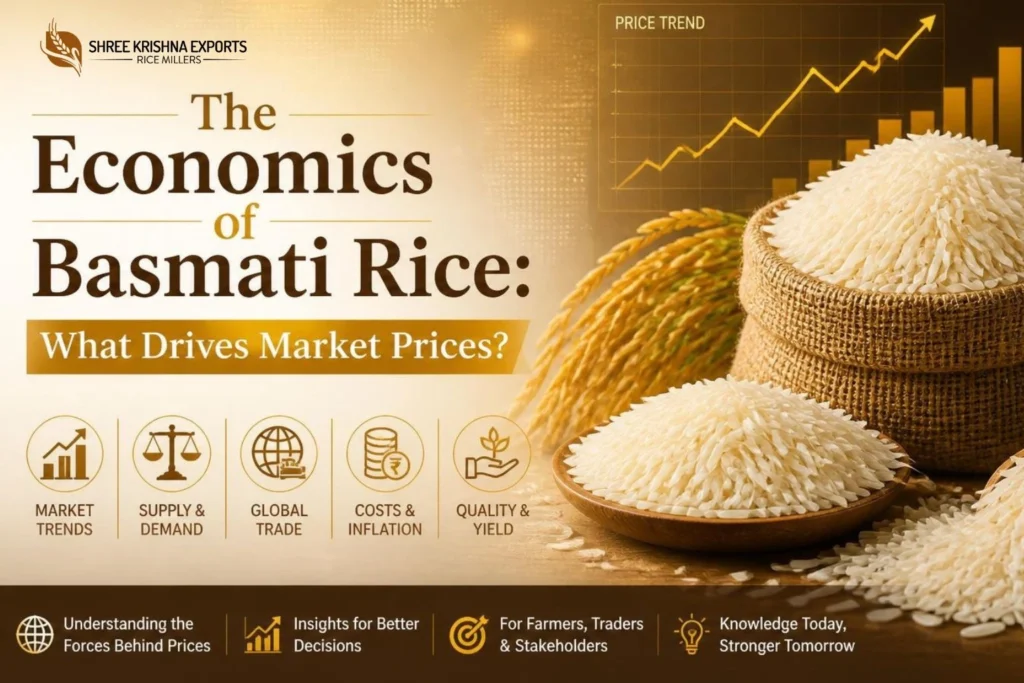
Basmati rice buyers are looking for the best deals, especially when purchasing in bulk quantities. However, if we compare the overall global price, the quotations vary. When choosing basmati rice exporters from India, the cost varies from supplier to supplier, even for the same variety. That is why most buyers are questioning the factors that actually drive the price of basmati rice.
Well, the answer is not as common as the supply and demand matrix. It depends on several other factors, including crop quality, crop yield, export regulations, customized packaging, freight costs, currency exchange rates, geopolitical stress, and global buying trends. To help buyers, importers, and distributors understand this in a better way, we are sharing all the factors below that govern the economics of basmati rice and its pricing.
Market Scenario: Know About Basmati Rice in Numbers
- India exported over 6.52 million tonnes of basmati rice in the financial year 2025-2026 with a total value of around ₹50,138 crore.
- Total export volume witnessed an increase of 7.5% in comparison to the previous year.
- Despite the increase in the total volume, the overall evaluation of value faced a dip of around 0.34%.
- Value dip took place due to global price corrections, Iranian Rial Crisis, and high freight costs that lowered prices, which resulted in the halt of new export contracts.
- Saudi Arabia and Iran top the list of top buyers with around 1.05 million metric tonnes and 1.0 million metric tonnes, respectively.
Sources Referenced
The market insights, export trends, and industry information presented in this post are based on publicly available data and reports from:
• Agricultural and Processed Food Products Export Development Authority (APEDA)
• Ministry of Commerce & Industry, Government of India
• Directorate General of Foreign Trade (DGFT)
• Industry trade reports and export market analyses
Note: Export volumes, market values, freight charges, and trade trends may vary over time based on market conditions, government policies, and global demand.
Why does the Basmati Rice Price Keep Changing?
We must understand that basmati rice is an agricultural commodity and its cost depends on several factors, including agricultural, economic, geopolitical, and many more. Let’s explore some of the most relevant factors that highly influence the market prices of basmati rice.
Crop Yield and Harvest Quality
Premium-quality basmati rice with longer grain length, superior aroma, low moisture content, and excellent cooking characteristics generally commands higher prices in the market. When crop yields are lower than expected due to uneven rainfall, adverse weather conditions, soil quality issues, or other agricultural factors, market supply is reduced.
Processing and Ageing of Rice
Properly aged rice for up to 12 to 24 months requires proper storage, inventory management, and other sources to keep it fresh and protected. Ageing improves rice quality and increases its pricing.
Basmati Rice Variants
The price of basmati rice varies from variant to variant, and when it comes to premium varieties like 1121 sella basmati rice, 1121 golden sella basmati rice, 1509 basmati rice, the price is usually high. However, for variants, like pusa basmati rice and sharbati basmati rice, prices are slightly lower. Also, it depends on the quality of these basmati variants.
Global Demand Influences Export Prices
When importing countries increase procurement, the demand increases, which directly pushes prices upward. Similarly, slower global demand may create more competitive pricing opportunities for buyers. Usually, the export prices are mainly influenced by the major importers in the global market, mainly Europe, North America, Canada, the Middle East, and Africa.
Freight and Logistics Cost
Importers not only pay for the rice, but they also pay for the ocean freight, container availability, inland transportation, port handling charges, and insurance. Even when the market price for rice remains stable, the freight and logistics cost may change due to changes in shipment routes, delays in shipment due to geopolitical tensions, which result in increased shipping charges.
Government Policies and Export Regulations
You can expect changes in government policies, export policies, quality regulations, and international trade conditions that highly influence market behaviour and price.
How does Tasty Grain Support Buyers in Dealing with Basmati Rice Prices?
We at Shree Krishna Exports (Tasty Grain) understand that buyers need both quality and better pricing, and that is why we offer them basmati rice at the best market prices. However, we know that price is not the only driving factor, which is why we also focus on:
- Offering premium varieties of basmati rice
- Maintaining hygienic processing and packaging conditions
- Adhering to all Indian and International trade criteria
- Following stringent quality policies
- Completing all export-import documentation
- Maintaining a consistent supply for bulk orders
Conclusion
We now know that the economics of basmati rice involves far more than simple supply and demand. Crop quality, ageing, global demand, logistics, export policies, and market conditions all work together to influence basmati rice pricing. Buyers and importers who understand these factors are capable of sourcing high-quality rice while maintaining long-term supply relationships. At Shree Krishna Exports (Tasty Grain), we combine premium-quality Basmati rice with excellent service and transparent business practices to help global buyers get the quality they require at the best prices.
Frequently Asked Questions
Basmati rice prices are more competitive after the harvest season, although export demand, freight charges, and market conditions can still influence final pricing.
Yes, ageing improves aroma, texture, and cooking quality while increasing storage costs, making aged rice more valuable.
Planning purchases early, working with reliable exporters, placing bulk orders, and maintaining long-term business relationships often help buyers obtain better commercial terms.